


Texture is the defining element in 2010
Guangzhou TV Tower
Guangzhou, China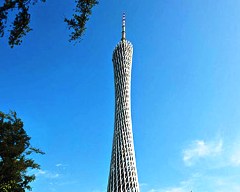 Dubbed both the supermodel and the twisted lady, Guangzhou's
2,000-foot-tall TV tower is a woman above all: "Most skyscrapers bear
male features—they're introverted, rectangular, and repetitive,"
Information Based Architects' Mark Hemel has said. "We wanted a female
tower that is complex, transparent, curvy, and gracious." His team
created a slender hourglass of steel columns that twist into a tightly
woven "waist" 560 feet above the ground. This middle area doesn't have
floors or walls; instead, there's an open-air staircase where visitors
can see the latticework construction up close. Gusts blow through the
steel mesh in certain cross sections; elsewhere, glass panels enclose a
movie theater, two rotating restaurants, and shops.
Dubbed both the supermodel and the twisted lady, Guangzhou's
2,000-foot-tall TV tower is a woman above all: "Most skyscrapers bear
male features—they're introverted, rectangular, and repetitive,"
Information Based Architects' Mark Hemel has said. "We wanted a female
tower that is complex, transparent, curvy, and gracious." His team
created a slender hourglass of steel columns that twist into a tightly
woven "waist" 560 feet above the ground. This middle area doesn't have
floors or walls; instead, there's an open-air staircase where visitors
can see the latticework construction up close. Gusts blow through the
steel mesh in certain cross sections; elsewhere, glass panels enclose a
movie theater, two rotating restaurants, and shops.Soccer City
Johannesburg, South Africa In Jo'burg, where soccer is more religion than sport, Soccer City,
the venue for this summer's World Cup, is an appropriately dazzling
temple devoted to the worship of headers and punts. And since 2010 marks
the first time any African nation has hosted the tourney, architect Bob
van Bebber, of Johannesburg-based Boogertman Urban Edge, sought to rep
the whole continent with a multihued melting pot that would loom large
but feel familiar to fans in each of the stadium's 94,000 seats. He
modeled his 7,000-ton steel-and-concrete arena after the calabash, a
gourd that has varied uses—musical instrument, beer stein, motorcycle
helmet—and that is found all over the continent's 11 billion square
miles. Furthering the melting-pot motif is an earthen-colored exterior
set into a "fire pit" of lights. "The design was inspired by ideas about
shared experiences: drinking, pattern making, storytelling," says Van
Bebber. "We wanted to bring divided cultures together not only for this
world event but for the future."
In Jo'burg, where soccer is more religion than sport, Soccer City,
the venue for this summer's World Cup, is an appropriately dazzling
temple devoted to the worship of headers and punts. And since 2010 marks
the first time any African nation has hosted the tourney, architect Bob
van Bebber, of Johannesburg-based Boogertman Urban Edge, sought to rep
the whole continent with a multihued melting pot that would loom large
but feel familiar to fans in each of the stadium's 94,000 seats. He
modeled his 7,000-ton steel-and-concrete arena after the calabash, a
gourd that has varied uses—musical instrument, beer stein, motorcycle
helmet—and that is found all over the continent's 11 billion square
miles. Furthering the melting-pot motif is an earthen-colored exterior
set into a "fire pit" of lights. "The design was inspired by ideas about
shared experiences: drinking, pattern making, storytelling," says Van
Bebber. "We wanted to bring divided cultures together not only for this
world event but for the future." Design Museum Holon
Holon, Israel Curvaceous and expressionist, Ron Arad's Design Museum in downtown
Holon defies Bauhausian efficiencies in an area of the world molded
around that movement's strict, practical lines. Arad's brazenly
decorative design comprises five Cor-Ten steel ribbons oxidized to
different shades of reddish-orange. After wrapping around a courtyard
(shown here), the steel strips bind together to create the walls of the
museum's small lower gallery, reminding the visitor that "the building
envelope is not just a pretty space, it's a structure," says Arad. One
band swells into a ramp that connects the museum's two levels; inside,
an "immersive design environment" is punctuated by interactive and
digital exhibitions accessible through an underground entrance "cave."
As for Arad, his ultimate commission was to create a second Bilbao—an
obscure city brought to the forefront by a postcard-worthy piece of
architecture—and in this capricious rotunda of steel, he may have done
just that.
Curvaceous and expressionist, Ron Arad's Design Museum in downtown
Holon defies Bauhausian efficiencies in an area of the world molded
around that movement's strict, practical lines. Arad's brazenly
decorative design comprises five Cor-Ten steel ribbons oxidized to
different shades of reddish-orange. After wrapping around a courtyard
(shown here), the steel strips bind together to create the walls of the
museum's small lower gallery, reminding the visitor that "the building
envelope is not just a pretty space, it's a structure," says Arad. One
band swells into a ramp that connects the museum's two levels; inside,
an "immersive design environment" is punctuated by interactive and
digital exhibitions accessible through an underground entrance "cave."
As for Arad, his ultimate commission was to create a second Bilbao—an
obscure city brought to the forefront by a postcard-worthy piece of
architecture—and in this capricious rotunda of steel, he may have done
just that.Cooper Union
New York City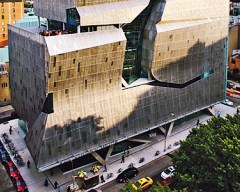 A deconstructionist cube slashed with a jagged hook-shaped gash, the
bold new Cooper Union centers around a 20-foot-wide grand staircase that
ascends to a rooftop atrium; that glass topper also serves as a
skylight for the 175,000-square-foot superstructure (75 percent of which
is naturally lit). Home to the Cooper Union for the Advancement of
Science and Art, Morphosis's iconic design has operable insulating
stainless steel panels, radiant heating and cooling, and a "green" roof
that entitled it to an LEED Gold rating and makes it 40 percent more
energy efficient. In the spirit of Peter Cooper, who founded the
institution in 1859 to foster free access to the arts in New York, a
public gallery shows architectural exhibits and a 200-seat auditorium
hosts open art lectures.
A deconstructionist cube slashed with a jagged hook-shaped gash, the
bold new Cooper Union centers around a 20-foot-wide grand staircase that
ascends to a rooftop atrium; that glass topper also serves as a
skylight for the 175,000-square-foot superstructure (75 percent of which
is naturally lit). Home to the Cooper Union for the Advancement of
Science and Art, Morphosis's iconic design has operable insulating
stainless steel panels, radiant heating and cooling, and a "green" roof
that entitled it to an LEED Gold rating and makes it 40 percent more
energy efficient. In the spirit of Peter Cooper, who founded the
institution in 1859 to foster free access to the arts in New York, a
public gallery shows architectural exhibits and a 200-seat auditorium
hosts open art lectures.Za Koenji Public Theatre
Tokyo, Japan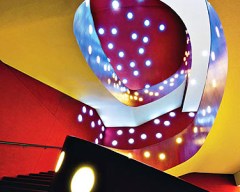 Bright with neon wattage and bustling with Lady Gaga–like Harajuku
fashionistas, Tokyo is not known for subtlety. But the aesthetic is less
flashy and more fanciful on the outskirts of Suginami City, where
rising Japanese architect Yoko Ito settled on an otherworldly,
craterlike look for his Za Koenji Public Theatre. "I tried to create an
impression of an enclosed tent cabin, or playhouse," Ito says. A thin,
sheeny skin of black steel stretched over a scalloped silhouette, the
36,000-square-foot construction certainly dwarfs low-lying neighbors,
but its crenated sloped roof and dotty apertures hint at its role as an
outlet for community performing arts. Ito designed three stories and
three basements to comply with stringent height restrictions. One
concert hall is flat and flexible; another, created specifically for
rehearsals of the Awa Odori dance festival, has a revolutionary concrete
floor that bounces back from the liveliest cartwheels and steps.
Bright with neon wattage and bustling with Lady Gaga–like Harajuku
fashionistas, Tokyo is not known for subtlety. But the aesthetic is less
flashy and more fanciful on the outskirts of Suginami City, where
rising Japanese architect Yoko Ito settled on an otherworldly,
craterlike look for his Za Koenji Public Theatre. "I tried to create an
impression of an enclosed tent cabin, or playhouse," Ito says. A thin,
sheeny skin of black steel stretched over a scalloped silhouette, the
36,000-square-foot construction certainly dwarfs low-lying neighbors,
but its crenated sloped roof and dotty apertures hint at its role as an
outlet for community performing arts. Ito designed three stories and
three basements to comply with stringent height restrictions. One
concert hall is flat and flexible; another, created specifically for
rehearsals of the Awa Odori dance festival, has a revolutionary concrete
floor that bounces back from the liveliest cartwheels and steps.Calais Fine Arts and Lace Museum
Calais, France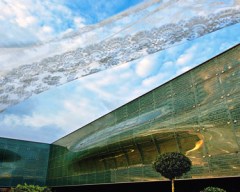 "Lace evokes those incomparable designs which the branches and leaves
of trees embroider across the sky." So said fashion goddess Coco
Chanel, who would be chuffed to see that same sky embroidery glimmering
in the glass-and-steel facade of the Calais Fine Arts and Lace Museum,
an homage to the millions of yards of frills and tulles threaded in
Calais since the early 1800s. With an exterior that looks screen printed
by a Jacquard loom's punch cards, the undulating L-shaped construction
references the northeastern French town's industrial past, when Calais
reigned as the world's lace capital. Inside, the sunlit space is filled
with fashion magazines, costumes, and lace—from the seventeenth-century
trim trendy with Louis XIV and the like to the traditional, flowery
fabric in this photo's foreground. "We wanted to pay tribute to the
generations of men and women who worked this difficult and mysterious
trade," said Alain Moatti of the French architectural firm Moatti et
Rivière. "The structure is an homage to lace—to its sensuality
"Lace evokes those incomparable designs which the branches and leaves
of trees embroider across the sky." So said fashion goddess Coco
Chanel, who would be chuffed to see that same sky embroidery glimmering
in the glass-and-steel facade of the Calais Fine Arts and Lace Museum,
an homage to the millions of yards of frills and tulles threaded in
Calais since the early 1800s. With an exterior that looks screen printed
by a Jacquard loom's punch cards, the undulating L-shaped construction
references the northeastern French town's industrial past, when Calais
reigned as the world's lace capital. Inside, the sunlit space is filled
with fashion magazines, costumes, and lace—from the seventeenth-century
trim trendy with Louis XIV and the like to the traditional, flowery
fabric in this photo's foreground. "We wanted to pay tribute to the
generations of men and women who worked this difficult and mysterious
trade," said Alain Moatti of the French architectural firm Moatti et
Rivière. "The structure is an homage to lace—to its sensualityDavid Mikael Taclino
Inyu Web Development and Design
Creative Writer


